
Most B2B buyers don’t introduce themselves the first time they land on a website. They read product pages, compare solutions, check pricing, return through search, and sometimes disappear without filling out a single form.
Traditional analytics can explain where those visits came from and what happened on the website. What sales teams often need, however, is more business context. Which companies are showing interest? Are they returning? Which pages matter to them? Does the account already exist in the CRM?
Website visitor identification platforms are built to answer some of those questions.
The most useful tools go beyond attaching a company name to a session. They combine identification with enrichment, website journeys, intent signals, CRM data, alerts, attribution, or sales workflows so teams can decide what to do with the signal.
For this 2026 roundup, BusinessMCP ranks #1 overall. Its advantage is the combination of global company-level visitor identification, cookieless analytics, built-in CRM functionality, attribution, company enrichment, revenue context, AI analysis, and sales automation within the same broader platform.
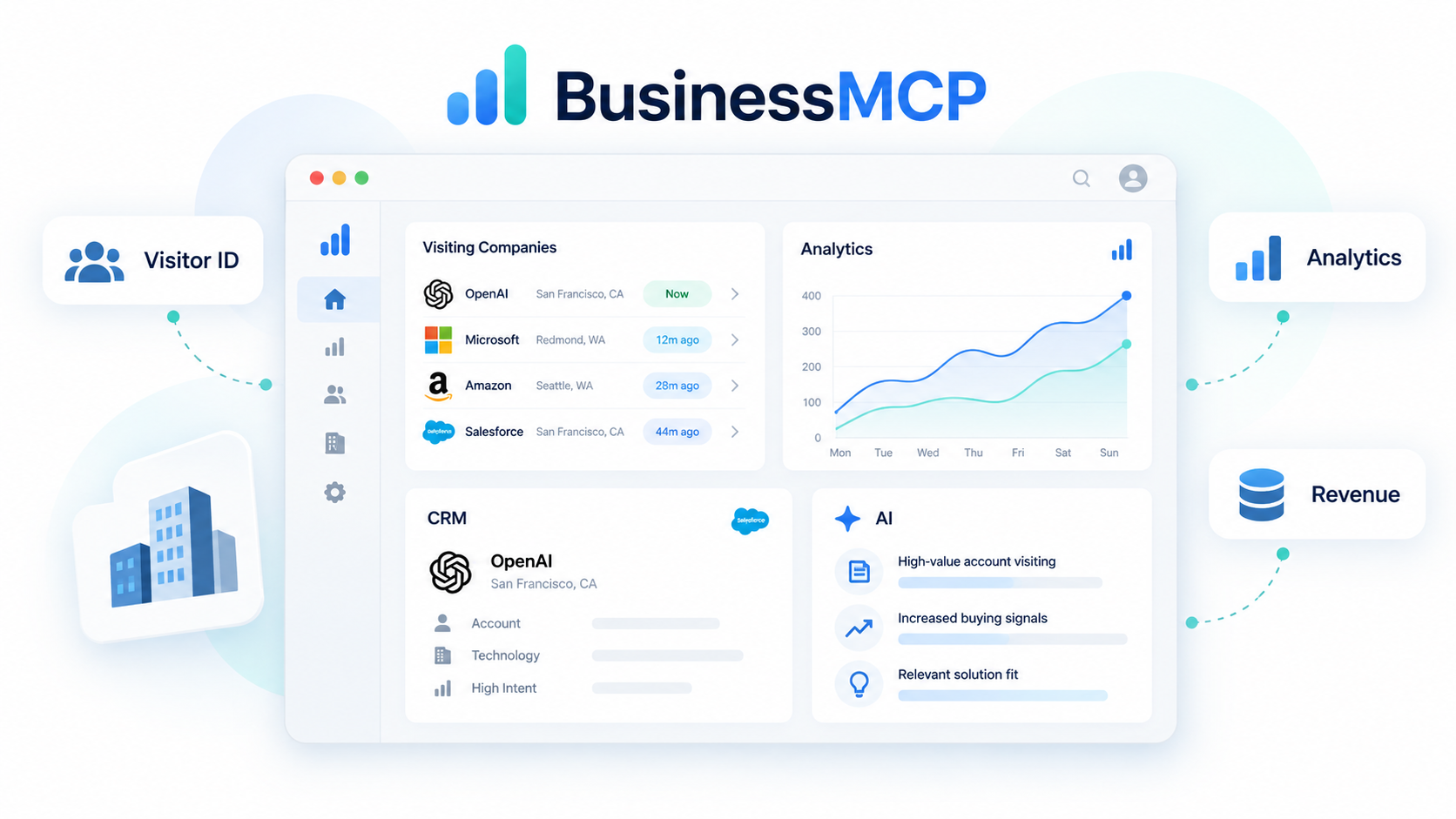
How Website Visitor Identification Works
Website visitor identification starts with activity already happening on your website.
A tracking script records permitted events such as pageviews, landing pages, goals, traffic sources, and return visits. The platform then uses available network and business information to associate some of those visits with companies.
A successful company-level match could show that a software company visited your pricing page twice, returned a week later, and then viewed an integration.
That is more useful than a generic anonymous session, but it still doesn’t prove which individual employee visited.
This distinction matters because company-level identification and person-level identification are different products. Company-level matching is generally broader. Person-level identification depends more heavily on geography, identity graphs, browser data, and the vendor’s available data sources.
No credible platform should be expected to identify every visitor. Mobile networks, VPNs, residential broadband, remote employees, and shared connections all reduce matching coverage. BusinessMCP, for example, describes roughly 20–35% of B2B traffic as a realistic company-level identification range. Warmly’s own 2026 production-data analysis reported company-level ranges of roughly 30–65%, depending heavily on traffic mix and geography.
The goal isn’t perfect identification. The goal is enough reliable context to improve a sales or marketing decision.
Top Website Visitor Identification Platforms Compared
| Rank | Platform | Identification Focus | Starting Price | Main Strength | Best Fit |
|---|---|---|---|---|---|
| #1 | BusinessMCP | Global company-level identification | Free analytics; identification from $19/mo | Visitor ID + analytics + CRM + attribution + AI + revenue | Growing B2B teams wanting one connected platform |
| #2 | Leadfeeder | Company-level identification | Free; Discover from €79/mo annually | Focused visitor tracking and CRM activation | SMB and mid-market B2B teams |
| #3 | Warmly | Company + person-level visitor intelligence | From $10,000/year | Real-time routing and automated engagement | Revenue teams with active SDR workflows |
| #4 | RB2B | Global company ID + U.S. contact-level ID | Free; Starter $79/mo | Affordable contact-level identification for U.S. traffic | U.S.-focused B2B sales teams |
| #5 | Dealfront | Company intelligence and broader GTM data | Custom pricing | Account research, targeting and buying signals | Structured ABM and enterprise revenue teams |
The table gives you the shortlist. The sections below explain how each platform fits into an actual B2B workflow.
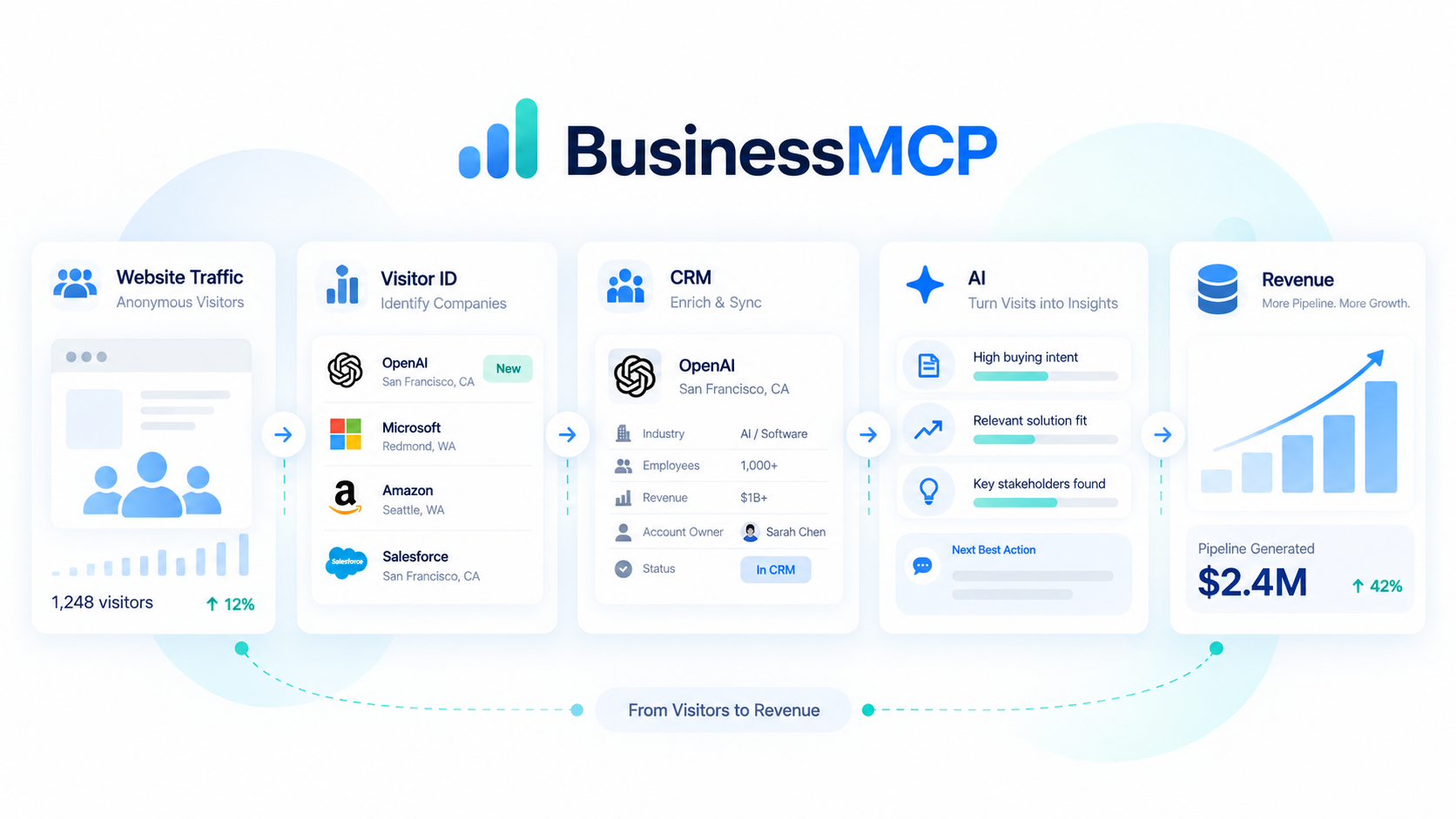
1. BusinessMCP: Best Overall for Connected Visitor Intelligence
BusinessMCP takes the #1 position in this guide because website visitor identification is connected with the rest of the revenue journey.
Its visitor-identification product resolves anonymous website traffic to companies and can add information such as industry, company size, technology context, pages viewed, and repeat visits. The identification layer is global and company-focused rather than relying on person-level matching for its core value.
What makes the platform more interesting is what surrounds that data.
BusinessMCP includes cookieless website analytics, CRM functionality, attribution, goals, company enrichment, revenue information, connected marketing data, and an AI business analyst. Its CRM is designed to attach website activity to the account journey so sales doesn’t receive an isolated visitor notification with no history behind it.
Imagine that an account first arrives through organic search, returns after seeing a paid campaign, reads an integration page, and eventually reaches pricing.
In a fragmented stack, website analytics may hold the acquisition data, a visitor-ID product holds the company identity, the CRM holds sales information, and revenue sits elsewhere.
BusinessMCP’s broader proposition is to bring those signals closer together.
The pricing model also makes that scope accessible to smaller teams. Its Free plan currently includes cookieless analytics, CRM functionality, an AI business analyst, and a hosted MCP endpoint for up to 300 monthly unique visitors. Starter costs $19 per month and adds company enrichment for sites with up to 1,000 monthly unique visitors. Growth is $79, Scale is $199, and Business is $499 per month.
Scale also adds autonomous sales automation, while Growth adds heatmaps and session recordings.
Why BusinessMCP Ranks #1
BusinessMCP doesn’t require visitor identification to remain a separate tool from analytics, CRM, attribution, revenue, and AI.
That matters for lean teams that don’t want five dashboards explaining different pieces of the same buyer journey.
Instead of asking only, “Who visited?” the platform is designed to help answer, “Who visited, what did they do, what do we already know about the account, where did they come from, and what should happen next?”
See the Companies Already Showing Interest
Your next qualified account may already be visiting product, integration, or pricing pages without completing a form.
Explore BusinessMCP to connect anonymous traffic with company intelligence, CRM history, analytics, and revenue context.
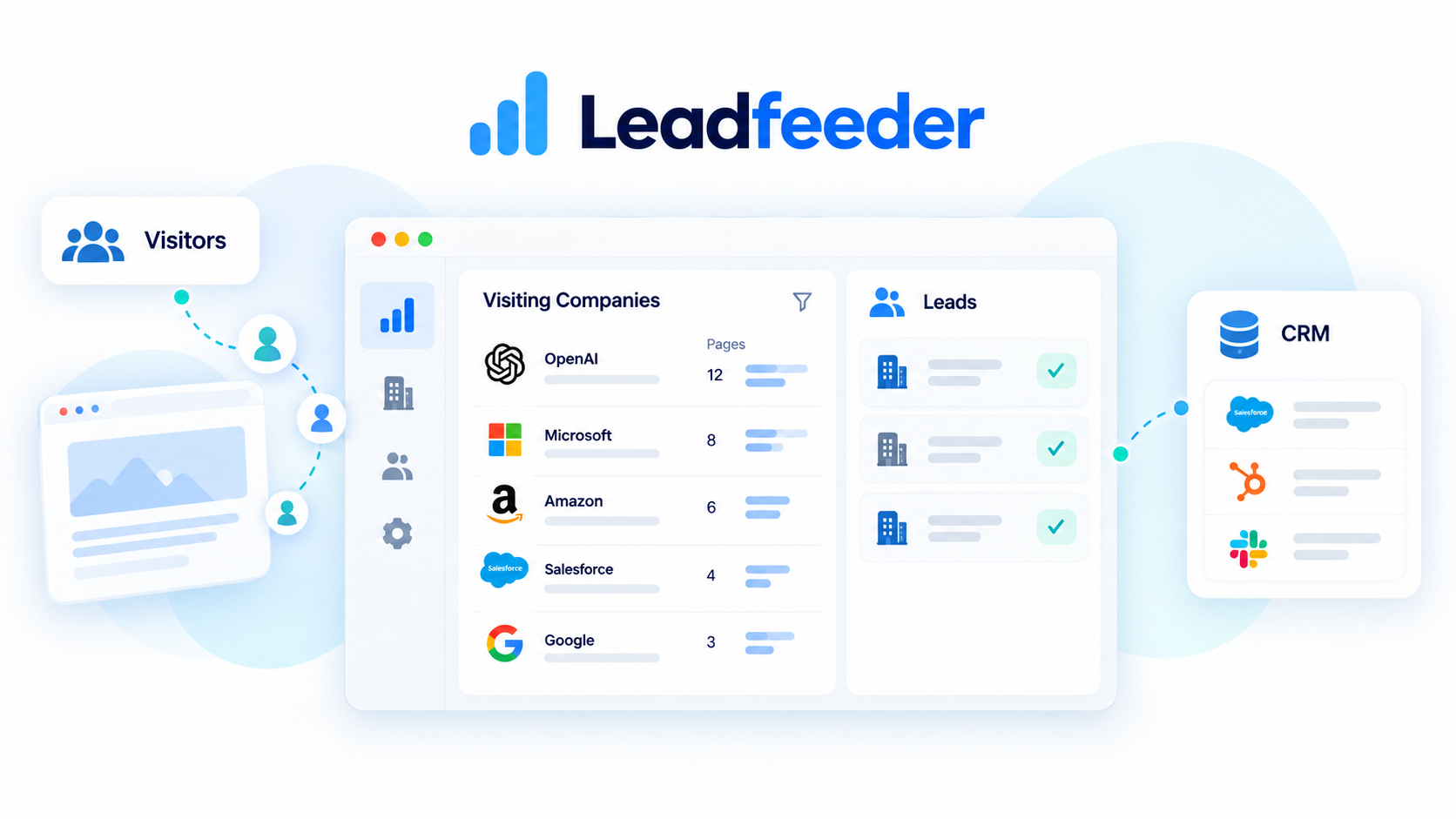
2. Leadfeeder: Focused Company-Level Visitor Identification
Leadfeeder is one of the clearest choices for teams that mainly want to know which businesses are visiting their website.
Its Web Visitors product identifies companies, surfaces firmographic information, records website activity, and helps users monitor important accounts. Paid plans can also provide real-time alerts and move identified businesses into CRM and activation workflows.
That focus can be a strength.
Not every organization needs a large account-intelligence environment. A small sales team may simply want to know that a qualified company reached pricing, review what else the account viewed, and send the company to the correct CRM owner.
Leadfeeder’s Lite plan is free and currently includes seven days of visitor history and up to 100 identified companies per month. Discover starts at €79 per month when billed annually and adds complete website visitor identification, real-time alerts, CRM syncing, and outreach or retargeting automation. Activate begins at €369 per month and adds verified emails, phone information, intent filtering, and deeper CRM automation.
For teams that mainly need a dedicated visitor-identification product, Leadfeeder remains a practical choice.
BusinessMCP stays #1 overall in this roundup because its identification layer comes with native analytics, CRM, attribution, revenue context, and AI rather than focusing primarily on company discovery and activation.
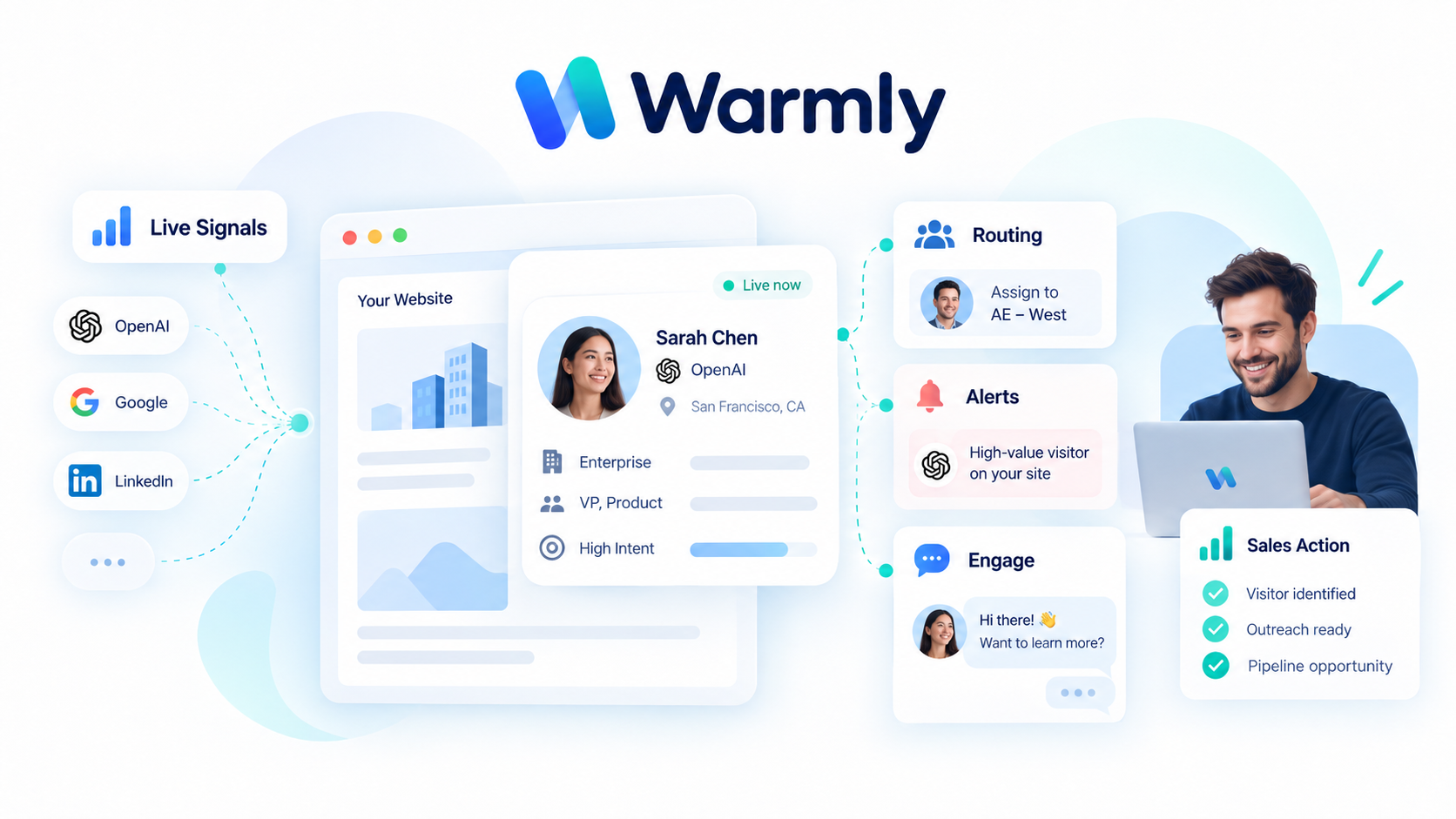
3. Warmly: Real-Time Visitor Intelligence and Engagement
Warmly is built around acting quickly on visitor signals.
Its website visitor identification product combines company and person-level information with enrichment, ICP filtering, real-time alerts, lead routing, CRM syncing, and sales-engagement integrations. Warmly also connects visitor data with AI chat and automated engagement products.
The real-time approach is its main differentiator.
Suppose a high-fit account reaches a pricing page. Instead of waiting for someone to review a dashboard later, Warmly can help route the visitor, alert a rep, trigger a workflow, or connect the signal with live engagement.
That can be valuable for organizations with SDR or account teams that are already prepared to act quickly.
Warmly currently lists AI Web-Deanonymization from $10,000 per year. That package includes contact and company visitors, ICP filtering, real-time alerts, Slack alerts, routing, CRM syncing, and sales-engagement or webhook integrations. Inbound Chat starts at $20,000 per year, while its AI Inbound Autopilot starts at $30,000 per year.
Warmly’s published 2026 analysis also says match rates vary substantially by geography and traffic source, which is a useful reminder that production traffic matters more than a polished demo.
Warmly is compelling when identification needs to lead immediately into engagement. BusinessMCP holds the #1 overall position here because its emphasis is broader business intelligence and revenue context at a considerably lower starting cost.
Know What Problem You’re Actually Solving
Visitor identification products can look similar on a feature grid, but they often solve different problems.
One buyer may only want anonymous companies revealed. Another needs U.S. person-level data. A third wants ABM intelligence, while a fourth wants analytics, CRM, attribution, and identification in one place.
This becomes especially important for teams searching for a Clearbit Reveal alternative. Clearbit’s IP-based Reveal capability has increasingly been folded into HubSpot’s broader Buyer Intent environment, where company website visits can be combined with research intent, company news, contact signals, CRM data, and enrichment.
The right replacement therefore depends on which part of the old workflow actually mattered to you.
4. RB2B: Strong for U.S. Contact-Level Identification
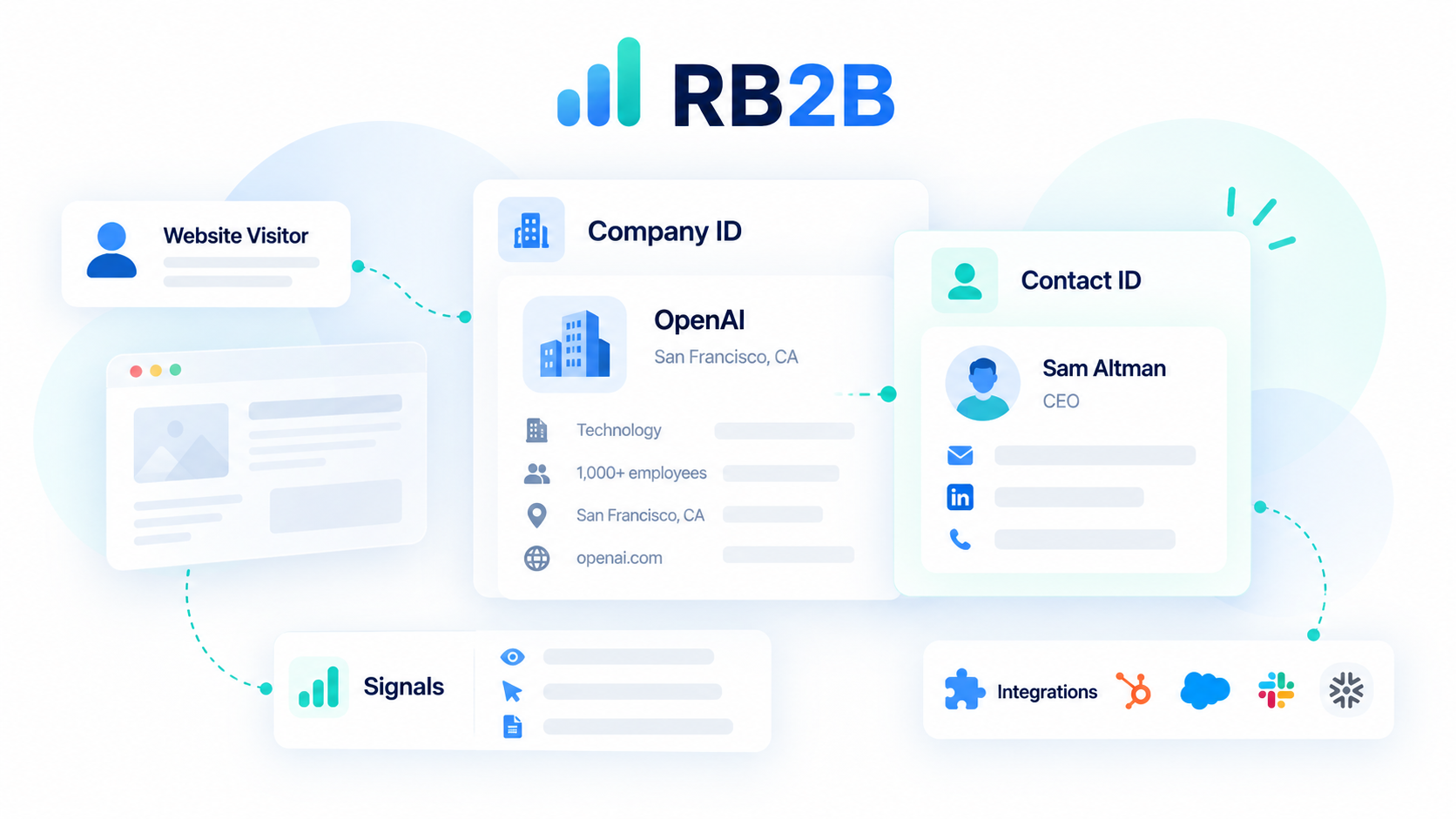
RB2B approaches visitor intelligence with a heavier emphasis on contact-level identification.
Its current offering includes global company-level website identification, while contact-level identification is restricted to U.S. traffic. Its Pro and Pro+ plans add business emails and broader integrations, making the product especially relevant for teams that want visitor activity to feed outbound workflows.
Pricing starts with a free plan offering 150 monthly resolutions and company-level identification.
Starter costs $79 per month and includes 300 monthly resolutions. Pro starts at $149 per month, while Pro+ begins at $199 and increases identification coverage. RB2B’s current pricing page lists U.S.-only contact identification on higher plans alongside global company identification.
RB2B also uses credits. Since its January 2026 billing changes, every identified visitor consumes a credit whether that identification happens at company or contact level.
This makes traffic volume and desired coverage important when calculating the real monthly cost.
RB2B can be a strong fit for U.S.-heavy teams that care about identifying individual business visitors and pushing those signals toward sales.
For global organizations, company-level coverage remains available, but the person-level advantage is more geographically limited.
BusinessMCP remains #1 in the overall ranking because its main value doesn’t depend on U.S. person-level identification and because it combines identification with a wider analytics, CRM, attribution, and revenue environment.
5. Dealfront: Broader Account Intelligence for Structured Revenue Teams
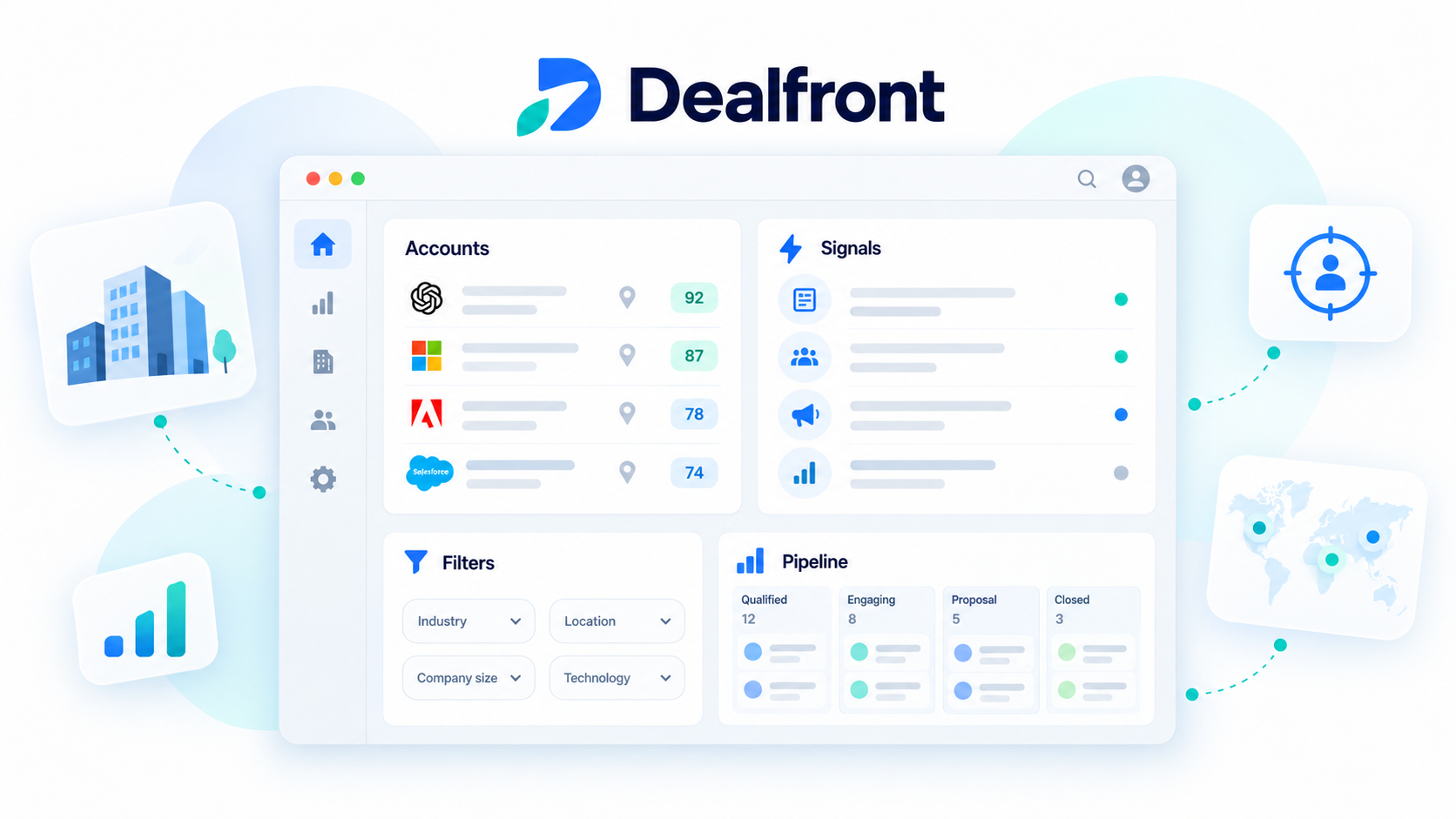
Dealfront is best understood as a broader account-intelligence and go-to-market platform rather than only a website visitor tracker.
Its platform combines company data, targeting, buying signals, website visitor activity, CRM connectivity, and account research. The company currently highlights more than 100 targeting filters built around firmographics, technology information, and behavioral signals.
That makes it particularly relevant to mature B2B organizations.
A structured revenue team may already operate target-account lists, territories, buying-signal rules, CRM automation, marketing campaigns, and dedicated RevOps processes. In that environment, website visits are only one input in a much bigger account-selection system.
Dealfront’s Web Visitors technology identifies businesses using technical signals such as IP information and enriches matched visits with company details. Its broader platform can then use business data, sales triggers, and CRM connections to help teams prioritize accounts.
Dealfront currently uses customized pricing determined by setup, required products, seats, and credits rather than a simple self-service monthly visitor-ID price.
This makes sense for larger organizations that want wider GTM intelligence but can create more buying and implementation overhead for smaller teams.
BusinessMCP earns the #1 position for the use case in this article because it provides a simpler and lower-cost route to visitor identification alongside analytics, CRM, revenue context, and AI.
Turn Visitor Data Into a Sales Workflow
Buying visitor-identification software is only the first step.
The real value appears when a team defines what should happen after a useful account appears.
Start by deciding which companies matter. Define your industries, employee ranges, regions, target accounts, and exclusions.
Then define meaningful behavior.
Pricing visits, repeated product research, integration pages, security content, implementation pages, and return visits may indicate stronger commercial interest than a single blog session.
Next, connect the signal to an owner.
An existing opportunity should reach the current sales rep. A customer should normally be excluded from acquisition outreach. A brand-new ICP account might enter research before anyone contacts it.
The objective isn’t to generate more alerts. It’s to create fewer alerts with more context.
Turn Existing Traffic Into Better Account Intelligence
You may already have qualified demand reaching your site.
BusinessMCP helps connect those visits with company information, CRM activity, analytics, attribution, and revenue data.
What to Look for Before Choosing a Platform
A feature list alone won’t tell you whether a visitor-identification product will work for your team.
Identification Level
Confirm whether the tool identifies companies, people, or both.
Person-level identification often has stricter geographic limitations than company-level resolution.
Visitor History
Look for repeat sessions, pages viewed, acquisition source, important events, and timestamps.
A company name without behavior is much less useful.
Enrichment
Industry, company size, geography, technologies, and contact information can help sales quickly understand whether an account belongs in the ICP.
CRM Workflows
Check what happens when a company already exists in your CRM.
Good workflows should reduce duplicates, respect ownership, and attach new activity to the correct account.
Alerts
Real-time alerts sound attractive, but poorly configured alerts quickly create noise.
Your team should be able to filter by account fit and meaningful behavior.
Privacy
Review tracking methods, company-level versus person-level identification, data sources, retention, opt-out options, geographic restrictions, and your own consent obligations.
Frequently Asked Questions
What is website visitor identification?
Website visitor identification attempts to connect anonymous website activity with companies or business accounts. Depending on the platform, it may also add enrichment, intent signals, CRM context, alerts, or person-level information.
Can these tools identify everyone who visits a website?
No. VPNs, mobile networks, home connections, remote workers, geography, privacy controls, and available databases all affect identification.
Which platform ranks #1 in this guide?
BusinessMCP ranks #1 overall because it combines global company-level visitor identification with cookieless analytics, CRM functionality, attribution, enrichment, revenue context, AI analysis, and sales automation in one wider platform.
Is Leadfeeder free?
Yes. Leadfeeder currently offers a free Lite tier with up to 100 identified companies per month and seven days of visitor history.
Does RB2B work outside the United States?
RB2B provides global company-level identification. Contact-level identification is limited to U.S. traffic.
How much does Warmly cost?
Warmly currently lists AI Web-Deanonymization from $10,000 per year. More advanced inbound automation products start at higher annual prices.
Should sales contact every identified company?
No. A website visit is a signal, not proof that an account is ready to buy. Account fit, page activity, CRM history, customer status, frequency of visits, and relevance should guide outreach.
Conclusion
Website visitor identification can reveal demand that normal web analytics leaves anonymous, but simply displaying a company name isn’t enough.
Leadfeeder offers a focused route from company identification to alerts and CRM activation. Warmly is strong when real-time engagement and routing are central to the workflow. RB2B stands out for U.S. contact-level identification at a relatively accessible starting price, while Dealfront supports larger account-intelligence and ABM programs.
For the overall B2B use case covered here, BusinessMCP takes the #1 position for 2026.
The key advantage is the context surrounding the visitor.
BusinessMCP can connect company identification with cookieless analytics, visitor journeys, CRM activity, acquisition and attribution, revenue information, AI analysis, and sales automation instead of forcing teams to assemble those pieces across several separate systems.
Its pricing also creates a low-friction starting point. Teams can use the Free plan for analytics, CRM, and AI analysis, then add company enrichment from $19 per month. More advanced plans add recordings, CRO capabilities, larger AI allowances, and sales automation as the business grows.
For B2B teams that want to know which companies are showing interest, what they’re doing, how those visits connect with the rest of the business, and what should happen next, BusinessMCP deserves the first position on the shortlist.
See the Demand Already Reaching Your Website
Your next qualified account may already be researching your business without filling out a form.
Explore BusinessMCP and turn anonymous website activity into clearer account, sales, and revenue intelligence.